Nobody Cares About Your Instagram Content (Let’s Fix That)
Instagram isn’t broken, the algorithm doesn’t hate you, and your account is not secretly shadow banned for no reason.
Low engagement is NOT random. It’s a sign that something in your content isn’t pulling its weight. No one cares, no one stops, no one engages.
People don’t engage with content just because you posted it. (You’re not Beyoncé). They engage when something feels relatable to them, useful to them, interesting to them, or beneficial to them in some way. In other words, it has to give them something of value. A reason to stop. A reason to care. A reason to engage.
Low engagement doesn’t automatically mean your content is bad. But it does mean something is missing the mark. Maybe you’re speaking to the wrong audience. Maybe your hook is too weak. Maybe the visual isn’t grabbing their attention. Maybe the content is fine, but there’s no real reason for anyone to do anything with it.
You can’t simply post on social and expect people to clap, just because you showed up.
It is about creating content that actually connects. Content with a purpose. Content that makes the right person stop and think, oh, this is for me.
So, let’s talk about the 5 most likely reasons your Instagram engagement is low, and how to fix them.
(If you’re just here for the freebie, I get it, it’s coming…)

You’re talking to the wrong people
Your niche and your audience are two different things. I find a lot of people know what their niche is, but when you ask them about their audience, their answer is usually something very vague.
“Urm… people who like coffee?” Yeah, that’s not going to cut it.
Speaking to the wrong people or struggling to refine your audience enough, creates a big disconnect between your content and the people you actually want it to land with and knowing what you sell is not the same as knowing who you are trying to sell it to.
The easiest way to explain this is with coffee… (Obviously)
Let’s say you run a small coffee business. Fine. That tells me your broad niche, but it still doesn’t tell me who exactly you are trying to reach.
Are you a location-based coffee shop selling to mums who need help surviving the school run?
Are you a modern chain focused on trend-led drinks and a work-friendly environment for business people?
Are you targeting gym-goers who want a pre-workout kick, with protein drinks and health-focused options on the menu?
Or are you a rural, family-run coffee shop in the countryside, focused on locals and tourists who want a slower, more traditional experience?
Same product, different person, different reason to care.
That is exactly where strategy comes into your content. All of those businesses sit under the same broad niche, but the audience, the messaging, the tone and the content angles would all need to be completely different. If you’re an online coffee brand specialising in organic blends, protein coffees and health-focused products, you are probably not going to market yourself the same way as a cosy village café trying to get walkers and weekend visitors through the door. The product category might be similar. The strategy should not be.
That is the bit people miss. They post the thing, talk about the thing, explain the thing… but forget to think about who the thing is actually for in the first place.
When your content is too broad, too vague, or aimed at the wrong person, it usually falls flat. Not because the offer is bad. Not because the business is bad. Just because the right people don’t recognise themselves in it and if they do not recognise themselves in it, they are not going to stop, care, or engage.
People engage when something feels like it was made for them. When the angle fits. When the wording feels familiar. When they can see themselves in the problem, the solution, or the point you are making.
That is why getting clear on your audience matters so much. If your content is trying to speak to everyone, it usually ends up landing with no one.
You’re Posting & Ghosting
Another reason your engagement might be low is a lack of consistency, and I don’t just mean you missed one upload and now you’re in algorithm jail.
I mean inconsistency in your content, your messaging, your replies and the way you engage with your audience too. The kind of inconsistency where you post a few times, disappear for two weeks, come back in a panic, post again and then vanish until the guilt kicks in. Posting and ghosting.
From an audience point of view:
People are far more likely to engage with creators and businesses they see regularly. The more often your content shows up, the more familiar and recognisable it feels, and that familiarity matters. When people get used to seeing you, they are more likely to stop, recognise your content, and interact with it over time. But if you keep disappearing, changing your tone every five minutes, or only replying to comments when you remember, you break that pattern. Your audience has no real reason to stay connected to an account that only pops up randomly when the motivation is there.
From Instagram’s point of view:
Inconsistency doesn’t exactly scream “push this content out.” For obvious reasons, the more you post, the more chance you have to be seen, build momentum, and grow. But that does not mean you need to post every single day if that is completely unrealistic for you (that’s a recipe for burnout). Posting seven days in a row and then disappearing for three weeks is not showing Instagram that you’re valuable. It is showing panic posting and unreliability.
The goal is to make social media a HABIT.
Choose an amount you can actually keep up with (be honest with yourself), leave time to reply to comments and DMs, and leave time to actually engage with the people engaging with you. Because consistency is not just about pushing content out. It’s about showing up properly. Engagement isn’t built on one good post, It’s built on momentum, and that’s very hard to build when you keep dropping off the face of the earth.
Your hooks are weak
You could have the most engaging piece of content on Instagram, but if your audience doesn’t realise that in the first three seconds, they’re never going to stick around long enough to find out. That’s exactly why hooks matter.
Your hook is the first thing people see. It’s the line or opening moment that decides whether someone keeps scrolling or actually gives your content a chance.
Its job isn’t to sound clever. It’s to stop the scroll. That’s it.
Because if people don’t stop, they don’t listen. And if they don’t listen, they don’t connect. And if they don’t connect, they’re definitely not liking, saving, sharing, or buying.

A lot of weak hooks have the same problem.
They are either too vague, too wordy, too safe, or trying far too hard to sound smart.
Things like:
“Happy Monday!”,
“Just a reminder…”,
“A little thought for today…”,
“Here are a few tips…”
or “New post is live…”
No offence, but none of that is exactly grabbing people by the eyeballs.
In general, the best hooks tend to be shorter and easier to process quickly. Statistically, hooks between five and eight words often perform well because they are clear, punchy, and easy to read in a split second.
That does not mean every single hook has to fit neatly into that formula, but it does mean this: if your opening line is long, clunky, or takes too much brain power to understand, people are gone. If you confuse them, you lose them.
And this is where the drunk grandma theory comes in. If your hook is overcomplicated, jargon-filled, or too “marketingy” that your drunk grandma would not understand it, it is probably too complicated. Because the best hooks aren’t the ones that sound the smartest. They are the ones that make sense the fastest. Simple wins. Clear wins. Fast wins.
That is why pain point hooks tend to perform well too. People react quickly to problems they recognise. A negative association usually grabs attention faster because people are wired to notice what is going wrong before they notice what is going right. So a hook like “Why your posts are getting ignored” is naturally going to stop more people than “A few content tips for today.” One sounds specific. One sounds like fluff.
Not all hooks do the same job. Some work because they call out a pain point, some work because they create curiosity, some work because they point out a mistake, some work because they challenge common advice and some work because they make the right person feel instantly seen.
The point is to write hooks that make the right person think “this is relevant to me”. Because once that happens, you have a chance. That’s what a hook is really doing: buying you a few more seconds. It’s not there to do the entire job of the post. It’s there to earn enough attention for the rest of your content to prove itself.
Sometimes the content underneath is actually decent, people just never got far enough to find that out.
(If this sounds like you, I’ve got a free 50 Scroll-Stopping Hooks ebook waiting for you at the end of this blog).
Hooks aren’t just words
Even if your wording is strong, your content can still fall flat if the visual side is making it hard to watch.
Some people focus so much on writing a better hook that they forget the content still has to look good, be readable, and worth engaging with. So you end up with a decent idea buried under a
not so pretty first slide, text that’s too small, weak contrast, too much going on, or a Reel that takes far too long to get to the point.
People aren’t going to work that hard for your content.
If the first slide feels messy, vague, or awkward to read, it immediately creates friction. Same with Reels. If the opening clip is slow, low-energy, or visually underwhelming, people lose interest quickly. That does not mean everything needs to look perfect or overly designed. But it does need to feel easy to take in.
Your first slide should make the main point obvious.
Your text should be easy to read quickly.
Your graphic should not feel crowded.
Your Reel should get to the point, immediately.
Sometimes the issue is not the content itself. It is the way it is being presented. If the packaging is weak, even a strong post can end up being ignored.
You didn’t ask, so you didn’t get
Sometimes people do care about the post. They stop, they read it, they might even agree with it. Then… absolutely nothing happens.
Why? Because you never actually told them what to do next.
A lot of business owners put all their effort into getting attention, then completely drop the ball at the end. The hook does its job, the content holds their attention, and then the post just… ends. No direction. No next step. No reason for someone to comment, save, share, click, or reply.
If you want engagement, you have to guide it. You cannot expect people to magically know what you want from them or what you’re offering them. Most people need a nudge. Not because they are stupid, lazy, or incapable of independent thought, but because people are busy, distracted and scrolling quickly. If the next step is not obvious, they will move on.
That does not mean every post needs a desperate “comment below!!!” slapped on the end of it. But it does mean your CTA needs to make sense. If you want people to save the post, give them a reason to save it. If you want people to share it, make it feel shareable. If you want people to comment, ask something worth responding to.
Because weak CTAs usually sound like this:
“Hope this helps.” “Let me know your thoughts.” “What do you think?”
And sometimes that is fine. But a lot of the time, it’s just filler at the end of a post. It sounds like you knew you should add a CTA, but had no real plan for what it was supposed to do.
A stronger CTA is clear, intentional and specific:
“Save this for later if your hooks need work.” “Send this to the business owner still posting Happy Monday.” “Comment “HOOKS” if you want the free guide.”
That’s the difference. If your content is not telling people why they should engage, a lot of them simply won’t. Not because they hated it. Not because it was bad.
Just because you didn’t ask.
Final thoughts
Low engagement does not always mean your content is bad, but it usually does mean something is missing the mark.Maybe you are speaking to the wrong audience, posting too inconsistently to build any real familiarity, using hooks that are too weak, visuals that are not doing enough, or CTAs that give people absolutely nothing to work with.
Whatever the reason, low engagement is usually a sign that something is not connecting. And honestly, that is useful. Because once you know what is not working, you can actually fix it.
The answer is not to panic-post for a week and then decide Instagram is broken. It is to look at your content properly, figure out where the disconnect is, and start creating posts that give people a reason to stop, care, and engage.
Because the goal isn’t just to fill the grid. It’s to create content that actually earns attention.
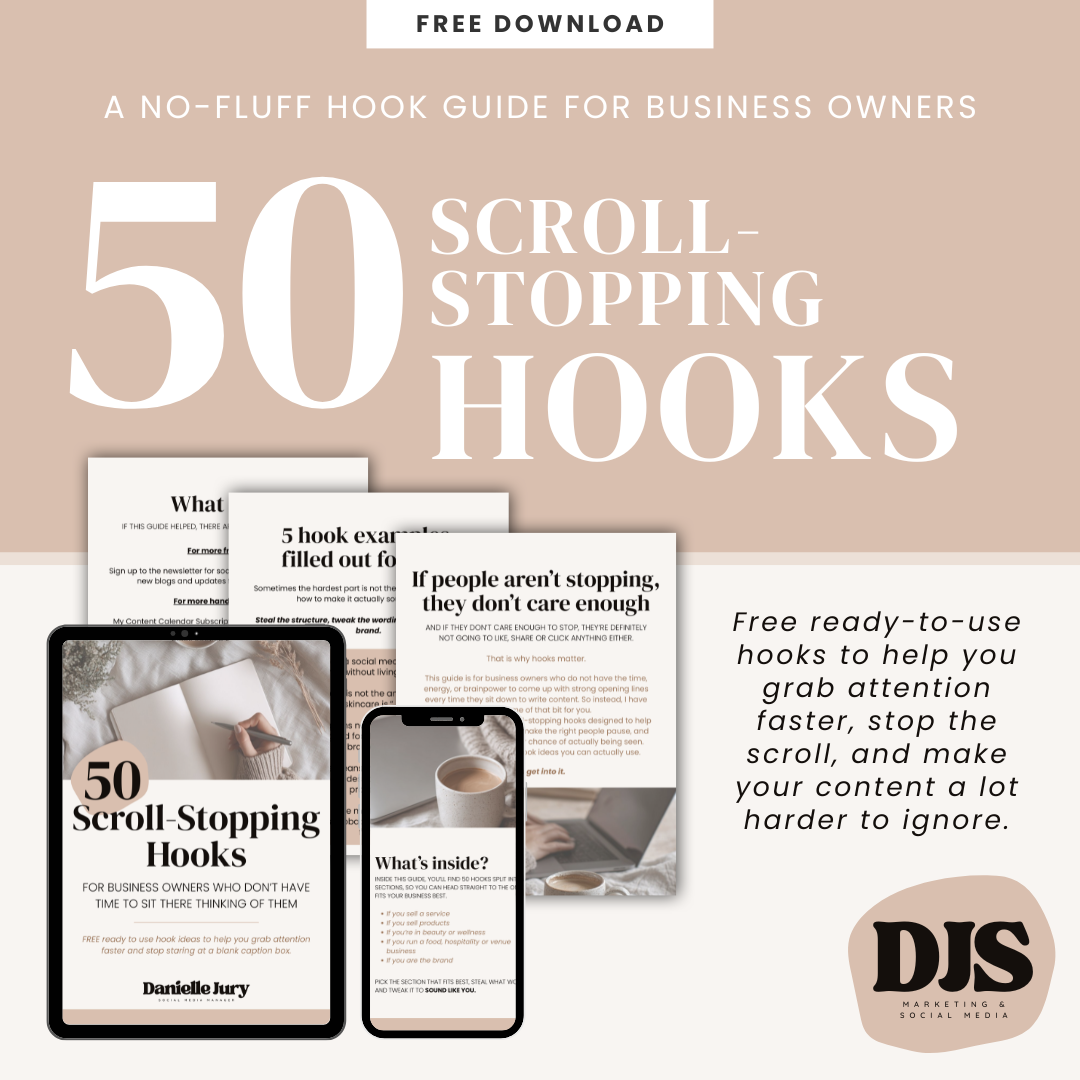
As promised, here’s that freebie!
If your hooks are one of the reasons your content is getting ignored, this is one of the first things I’d recommend you look at fixing.
My free 50 Scroll-Stopping Hooks ebook is designed to help you write better opening lines, grab attention faster and stop starting every post with something polite but painfully forgettable.